http://www.sfgate.com/cgi-bin/article.cgi?f=/news/archive/2004/01/07/international1540EST0638.DTL
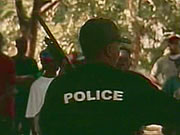
Haitian students march in
swelling movement against Aristide; clashes kill one, injure 13
PAISLEY DODDS, Associated Press Writer
Wednesday, January 7, 2004
(01-07)
12:40 PST PORT-AU-PRINCE, Haiti (AP) --
Following the example of
student movements that helped topple two presidents, university students marched
against President Jean-Bertrand Aristide on Wednesday in a protest marred by
bloody clashes that killed at least one person and wounded 13.
Aristide partisans armed
with clubs, bottles and pistols jumped down from pickups to block the marchers,
who were joined by thousands of anti-government demonstrators shouting "Freedom!"
and "Down with Aristide!" Riot police fired shots to keep government
partisans away.
At the beginning of the
protest, Aristide supporters attacked demonstrators, hitting one with a rock and
shooting another. Later, police shot and killed an Aristide supporter after he
opened fire on the crowd.
At another leg of the march,
government partisans opened fire, wounding two demonstrators. The Aristide
supporters then surrounded a group of students, stabbing one and beating six
others. Students beat two Aristide supporters.
"Under Aristide there
will be no progress," said protester Leopold Willeens, 26. "I'm the
first student in my family to go to university, and I want a better life."
Gunfire crackled throughout
the day as smoke billowed from burning tire barricades. Demonstrators re-grouped
when Aristide supporters attacked with bullets and rocks. Organizers stopped the
march when police warned they could no longer guarantee security.
The anti-government
demonstrators and students accuse Aristide of being power-hungry and failing to
help the poor. In a country where an estimated 40 percent of the 8 million
people are under 18, such activism carries weight.
Student protests and
strikes helped oust President Elie Lescot in 1946, followed by Paul Magloire in
1956. Their opposition also led to the weakening of the Duvalier family
dictatorship, which imprisoned many students during its 29-year regime until
1986.
The marchers join a
swelling youth protest movement as many face a bleak future. Most Haitians are
jobless or without regular work, foreign investment is at a standstill and
foreign visas to countries such as the United States and France are increasingly
hard to obtain.
_________________________________________________________
http://www.nytimes.com/2004/01/08/international/americas/08BRIE2.html?ex=1074142800&en=3ba9e6d045da0288&ei=5062&partner=GOOGLE
HAITI:
2 DEAD IN PROTEST AGAINST ARISTIDE Thousands of demonstrators marched in
Port-au-Prince against President Jean-Bertrand Aristide in a protest that left
two dead and more than two dozen injured after Aristide partisans armed with
clubs, bottles and pistols swooped down from trucks to block the marchers, and
the riot police fired shots to keep the partisans away. (AP)
http://news.bbc.co.uk/go/pr/fr/-/2/hi/americas/3378013.stm
Published: 2004/01/08 03:49:52 GMT
Eyewitness:
Haiti protests
By Claire Marshall
BBC correspondent in Port-au-Prince
In the searing Caribbean
heat, thousands of opposition supporters flooded through the streets of the
Haitian capital Port-au-Prince, chanting, "Aristide, Go! Aristide - we are
mobilising!"
"The
situation in Haiti is very bad - now the whole population is against
Aristide," said one man, draped in the red and blue Haitian flag.
"Everybody
is just tired - everyone wants to see a change," another young man said,
his face beaded with drops of sweat.
Even
as they spoke, stones started flying through the air, as the demonstrations
turned violent.
Intimidation
Groups
of Jean-Bertrand Aristide supporters - hired thugs known as "chimeres"
- roamed the streets clutching automatic weapons, and wearing black masks.
Their
aim was clearly to intimidate people and to disrupt the demonstrations.
In
the early afternoon, riot police wearing black padded body armour, and carrying
handguns tried to disperse sections of the crowd in a downtown area of the
capital.
The
sound of bullets being fired sent people running for cover. Moments later, a man
was walked up the street with blood pouring from a gunshot wound to his arm.
"Look
at this!" cried a man helping him, "This is what Aristide does."
People
from all sectors of society took part in the demonstrations, including students
and businessmen.
Poverty
and misery
According
to some Haitians, these are the biggest protests to have taken place for at
least 10 years - when the dictatorial Duvalier regime was swept from power, and
Mr Aristide emerged as leader.
They
come as Haiti celebrates 200 years since winning independence from France.
A victorious slave revolt against Napoleon's troops
brought about the creation of the world's first black republic.
However,
independence has brought Haiti little but misery and poverty.
It
is the poorest country in the western hemisphere, with most people existing on
less than a dollar a day, and an average life expectancy rate of just over 50.
The
opposition movement's goal is to start to try and change this, by getting rid of
President Aristide.
The
president himself has pledged to call new elections this year.
However,
his opponents want him out now.
One
Port-au-Prince resident believes that this moment isn't far away.
"This
can't go back now. Aristide has to go - either by force, or peacefully - as we
want him to."
_______________________________________________________________
http://www1.bluewin.ch/infos/index.php/international/20040108:bwf006/
08.01.2004
01:54
Haïti:
deux morts au moins au cours d'une manifestation
PORT-AU-PRINCE
- Deux personnes au moins ont été tuées mercredi dans des affrontements entre
partisans et adversaires du président haïtien Jean-Bertrand Aristide, selon
des témoins. C'est la deuxième manifestation de masse de l'année à
Port-au-Prince.
[ats]
- Plusieurs milliers de manifestants, accusant le chef de l'Etat de corruption
et de violation des règles démocratiques, ont essuyé des jets de projectiles
divers et des tirs d'armes à feu. Plusieurs boutiques ont en outre été dévalisées
et des agents de sécurité désarmés.
Au moins un passant a été tué par balles, selon des témoins qui ont également
signalé plusieurs blessés. Un homme armé installé à l'arrière d'une Jeep
transportant des partisans de M. Aristide a par ailleurs été abattu par
la police.
Le 1er janvier, les festivités organisées à l'occasion du bicentenaire de
l'indépendance avaient déjà tourné à l'émeute. Des manifestations organisées
pour réclamer le départ de M. Aristide ont lieu quasi quotidiennement.
Depuis la mi-septembre, des dizaines de personnes ont trouvé la mort dans les
violences politiques.
(Manque
URL)
09 Jan 2004 23:50

Second
jour de grève contre Aristide en Haïti
par
Amy Bracken
PORT-AU-PRINCE
(Reuters) - La plupart des banques, des écoles, des stations essences et des
entreprises haïtiennes sont demeurées fermées vendredi, au second jour d'une
grève visant à obtenir le départ du président Jean-Bertrand Aristide. Un
porte-parole de la présidence a estimé que ce mouvement n'était pas révélateur
de l'état de l'opinion publique.
Reste que cette grève,
qui n'a pas été suivie dans les services publics et dans les petites
entreprises, intervient dans un contexte de tensions croissantes entre partisans
et opposants du président.
Au moins deux personnes
ont été tuées mercredi dans des affrontements entre ces deux camps à
Port-au-Prince. Washington a condamné vendredi les autorités haïtiennes,
accusées d'avoir laissé des "bandes soutenues par le gouvernement"
attaquer des manifestants réclamant le départ du président.
Un des chefs de file de
la grève, le docteur Jean Henold Buteau, a affirmé que la vingtaine de médecins
de sa clinique suivaient ce mouvement, de même que les médecins des hôpitaux
de Port-au-Prince, à l'exception des urgentistes.
"La grève n'est
pas générale parce que les petits commerçants ne peuvent pas se permettre
d'arrêter de travailler", a-t-il dit, tout en jugeant que le mouvement était
une réussite.
CORRUPTION
Mario Dupuy, un
porte-parole de la présidence, a condamné la grève et appelé au dialogue.
"Ce mouvement est
une menace pour le droit à l'éducation et la liberté économique de chaque
citoyen, de même que pour les libertés de déplacement", a-t-il dit dans
un communiqué.
Des manifestations
organisées pour réclamer le départ d'Aristide ont lieu quasi quotidiennement.
Depuis la mi-septembre, des dizaines de personnes ont trouvé la mort dans les
violences politiques.
Le 1er janvier, les
festivités organisées à l'occasion du bicentenaire de l'indépendance avaient
déjà tourné à l'émeute.
Aristide a été en
1991 le premier président haïtien démocratiquement élu. Mais peu après, il
a été chassé du pouvoir par un coup d'État militaire.
A son retour d'exil en
1994, grâce à l'aide des forces américaines et de l'Onu qui ont écarté le
dictateur Raoul Cedras, Aristide a repris ses fonctions mais sa popularité a
commencé à décliner.
Son parti a remporté
haut la main les élections législatives de 2000 et Aristide a été réélu
cette année-là à la présidence, mais les dirigeants de l'opposition ont mis
sérieusement en doute la légitimité des deux scrutins.
Certains anciens
partisans ont accusé alors Aristide de trahir ses alliés et d'oublier ses
promesses électorales. Les bailleurs de fonds internationaux ont commencé à
se demander où finissaient les sommes prêtées et des opposants, tant en Haïti
qu'en exil, ont pointé du doigt la corruption du régime Aristide.
Plus la population a
manifesté ouvertement son opposition au chef de l'Etat, plus les forces de
police, les milices du parti au pouvoir et des bandes de malfrats ont répliqué
par des menaces ou des violences physiques.
Haïti reste un pays
affligé par une pauvreté extrême et des violences politiques. Le taux de chômage
dépasse les 70% de la population active, le revenu moyen n'atteint pas un
dollar par jour et l'espérance de vie moyenne oscille autour de 50 ans.
http://servihoo.com/channels/kinews/v3news_details.php?id=28771&CategoryID=49
Mot d'ordre de grève générale en Haïti où l'espoir d'une
solution s'amenuise
[09
Jan 2004]
PORT-AU-PRINCE
(AFP)
L'espoir
d'une solution à la crise politique en Haïti apparaissait jeudi extrêmement
faible, au premier jour d'une grève générale de 48 heures lancée par
l'opposition et la société civile pour obtenir le départ du président Jean
Bertrand Aristide.
Au
lendemain d'une journée de violences qui ont fait deux morts et une trentaine
de blessés, les activités étaient réduites à Port-au-Prince où le grand
commerce et la plupart des banques privées sont restés fermés. En revanche,
le commerce informel et les marchés populaires fonctionnaient presque
normalement, ainsi qu'une partie des transports en commun.
Aucun
incident n'a été signalé et de nouvelles manifestations de l'opposition et de
la société civile ne sont pas prévues avant dimanche.
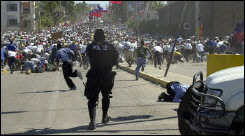
Les
violences de mercredi ont été le fait d'activistes armés du pouvoir et de
civils armés - appartenant à la garde du Palais présidentiel, selon certains
témoignages de l'opposition - qui ont ouvert le feu sur les manifestants, échangeant
parfois des coups de feu avec des membres de la police anti-émeutes.
Pour
la Plate-forme démocratique de la société civile et des partis de
l'opposition, ces violences "montrent une fois de plus que tout accord avec
M. Aristide est illusoire et que la seule solution est sa démission".
Le
gouvernement, de son côté, par la voix de son secrétaire d'Etat à la
Communication, Mario Dupuy, a rejeté sur l'opposition et la société civile la
responsabilité de ces "violences programmées".
 Se
disant "très préoccupé par la situation en Haïti", le secrétaire
d'Etat américain Colin Powell a appelé jeudi à Washington les deux parties à
se saisir d'un compromis proposé par la Conférence épiscopale catholique en
novembre pour mettre fin à la crise politique qui perdure depuis 2000.
Se
disant "très préoccupé par la situation en Haïti", le secrétaire
d'Etat américain Colin Powell a appelé jeudi à Washington les deux parties à
se saisir d'un compromis proposé par la Conférence épiscopale catholique en
novembre pour mettre fin à la crise politique qui perdure depuis 2000.
"Nous
encourageons le président de Haïti ainsi que l'opposition à se saisir de
cette proposition" qui "apporterait un peu d'ordre au processus
politique et fournirait un cadre constitutionnel afin que les Haïtiens puissent
exprimer leur volonté", a indiqué Colin Powell.
Le
compromis de l'Eglise prévoit la création d'un Conseil de neuf membres auprès
du chef de l'Etat, représentant la diversité de la population dont
l'opposition. Accepté par le président, il a été rejeté par l'opposition.
Pour
Mario Dupuy, les violences de mercredi traduisent une volonté de l'opposition
"de faire échouer une tentative de médiation du Caricom",
l'organisation des pays des Caraïbes dont Haïti est membre. Une mission du
Caricom dirigée par le Trinidadien Colin Granderson a quitté mercredi
Port-au-Prince après avoir rencontré les principaux acteurs de la crise.
Mais
la Plate-forme qui juge le Caricom trop favorable au chef de l'Etat a rejeté sa
médiation. Elle entend alterner manifestations et grèves contre le pouvoir
pour contraindre le président à démissionner.
Mais
cette stratégie, dont l'opposition a abusé contre le pouvoir militaire au
lendemain de la chute de la dictature des Duvalier (1986), n'est pas toujours
payante, car le secteur informel et populaire (près de 80% de l'économie) qui
vit au jour le jour avec souvent moins d'un dollar quotidien, ne respecte pas la
grève dans la plupart des cas.
L'opposition
a lancé un appel au secteur informel pour qu'il suive son mot d'ordre mais ne
semblait pas jeudi avoir été entendue au premier jour de la grève qui doit
s'achever vendredi.
Le
parti Lavalas au pouvoir a pour sa part appelé la population à contrecarrer la
grève "qui punit le peuple", et a stigmatisé par la voix de son
porte-parole, Jonas Petit, "ceux qui envoient leurs enfants dans des écoles
étrangères et veulent fermer (par la grève) les écoles des enfants du
peuple".
http://www.news.com.au/common/story_page/0,4057,8370611%255E1702,00.html
Thousands call for president to go
From correspondents in Port-au-Prince
January 12, 2004
TENS of thousands of protesters have gathered for the
largest demonstration so far calling for Haitian President Jean Bertrand
Aristide's resignation, while a ruling party supporter has been shot dead.
Supporters of Aristide's Lavalas party engaged in stone throwing in the capital,
Port-au-Prince, as anti-riot police stood by to ensure a peaceful demo by the
Democratic platform, comprising civilian organisations and opposition parties.
Meanwhile, in south west Haiti, the death of a Lavalas
party activist at Miragoane led to a violent attempt at reprisals, with party
members attempting to burn alive an opposition supporter.
The victim was taken to hospital in serious condition.
Both sides have denied shooting the activist, each
blaming the other.
http://www.lalibre.be/article.phtml?id=10&subid=83&art_id=149101
HAÏTI
Manifestation
d'envergure contre le président Aristide
Mis en ligne le 11/01/2004
Plusieurs dizaines de milliers de personnes ont manifesté
pacifiquement dimanche en fin de matinée à Port-au-Prince pour réclamer la démission
du président Jean Bertrand Aristide, a constaté un journaliste de l'AFP.
Cette manifestation, à l'appel de la Plate-forme démocratique de
la société civile et des partis d'opposition, est la plus importante de toutes
celles organisées par l'opposition depuis l'automne.
Quelques tentatives de partisans du pouvoir de troubler le défilé
du cortège par des jets de pierres ont échoué, devant la fermeté de la
police anti-émeute présente pour encadrer le cortège.
La manifestation avait commencé avec le rassemblement de mille
manifestants après un service religieux à l'Eglise Saint-Pierre de Pétion-Ville,
une banlieue résidentielle du sud de la capitale.
L'évêque auxiliaire de Port-au-Prince, Mgr Pierre André Dumas,
avait exhorté les manifestants durant la messe à «ne pas avoir peur»,
leur assurant que la «victoire» était au bout du chemin, et qualifiant
le compromis de sortie de crise proposé fin novembre par les évêques haïtiens
d'affaire «passée qui devait rester dans le tiroir où elle se trouve».
Ce compromis, qui prévoit de profondes réformes dans la police et
d'entourer le chef de l'Etat d'un Conseil de neuf sages issus de la société
civile et de l'opposition, a reçu l'appui des Etats-Unis et de la France et a
été accepté par M. Aristide.
La plate-forme de l'opposition l'a cependant refusé, y voyant »une
tentative désespérée» du président haïtien pour garder le pouvoir.
Partis de Pétion-Ville, les manifestants portaient une large bannière
arborant, avec les armes d'Haïti et la devise du pays »L'union fait la force»,
l'inscription «Marchons pour une nouvelle Haïti».
Les organisateurs avaient demandé aux participants de rentrer
leurs chemises dans leurs pantalons pour bien montrer qu'ils ne portaient pas
d'armes.
http://www.sfgate.com/cgi-bin/article.cgi?f=/news/archive/2004/01/11/international2138EST0552.DTL
Tens
of thousands march against Haitian president; northern police chief shot dead
MICHAEL NORTON, Associated Press Writer

Sunday, January 11, 2004
(01-11)
18:38 PST PORT-AU-PRINCE, Haiti (AP) --
Tens of thousands of
Haitians marched in the largest such demonstration against embattled President
Jean-Bertrand Aristide on Sunday as political tensions across the country grew.
The march began at a church
outside of the capital with about 1,000 people carrying a banner calling for
"Another Haiti." But the crowd swelled to tens of thousands as the
protesters approached Port-au-Prince.
Riot police followed the
protest. No injuries were reported, but Aristide partisans threw sticks at the
marchers at one point.
"Don't be afraid!"
Rev. Pierre Andre Dumas, a Catholic bishop, told the crowd. "We need to
take another path so that Haiti can live."
Meanwhile, the body of
district police commander Jeanty Edner was found Sunday morning on a street in
north-coast Cap-Haitien, Haiti's second largest city, news reports said. He was
shot in the chest, but the motive was not clear.
In a separate protest, an
Aristide supporter was shot and killed in the town of Miragoane, some 50 miles
west of the capital, private Radio Vision 2000 reported.
It was not clear who shot
him, but Aristide partisans retaliated and set an anti-government protester on
fire, the radio station said. The man was hospitalized but his condition was
unclear.
During protests in the past
four months, at least 46 people have been killed and more than 100 wounded. Both
sides blame each other for the violence, but most of the deaths have been anti-government
protesters.
"We want nonviolent
demonstrations, but they want civil war," said Cirvil Bernier, a
44-year-old construction worker and Aristide partisan. "That's why we want
to stop them."
Government critics accuse
Aristide of being power-hungry, while the government accuses the opposition of
impeding progress. Tensions have been rising since Aristide's party won 2000
legislative elections that observers said were flawed.
The
opposition refuses to participate in new elections unless Aristide steps down,
but he says he will serve out his term until 2006.
http://www.ndtv.com/morenews/showmorestory.asp?slug=Violence+mars+protest+march+in+Haiti&id=47590
Violence mars protest march in Haiti
Monday, January 19, 2004 (Port au Prince):
At least six people were injured by gunfire when government supporters
clashed with riot police who were protecting a large march by the opposition in
the Haitian capital Port-au-Prince on Sunday.
Gunfire erupted after the march, attended by tens of thousands of people,
reached Delmas Ave, a main thoroughfare.
Heavily armed riot police rushed into the narrow side streets making at least
two arrests and confiscating one weapon.
Francoise Brunaire, a 26-year old street vendor was shot in the leg as she tried
to flee a volley of gunfire which appeared to come from the Haitian national
television building.
March organisers kept control of the large crowd and prevented most from rushing
off into the side streets looking for the gunmen.
The march continued at a fast pace with riot police urging the demonstrators to
keep moving.
The anti-government marchers want the removal of President Jean-Bertrand
Aristide - or at least a date for free and fair elections.
The loose coalition of opposition groups claim there is no democracy in Haiti,
the poorest country in the western hemisphere.
Protest marches have become an almost daily occurrence in Port Au Prince and
other Haitian towns in past weeks. (AP)
http://www.ndtv.com/morenews/showmorestory.asp?slug=Unrest+continues+in+Haitian+capital&id=47642
Unrest
continues in Haitian capital
An angry crowd of university students pelted police
with rocks and tried to erect burning barricades in Port au Prince, Haiti on
Monday.
The students had earlier tried to stage an anti-government demonstration to mark
Martin Luther King Day, but when they deviated from an agreed route, riot police
blocked their path.
The students had hoped to pressure high school teachers into going out on a one
day strike, but many schools remained open.
A small group of around 100 students from the State University occupied a roof
top and pelted passing police vehicles with rocks and bottles. They rolled a car
onto the main street and tried to set it alight.
The police responded with volleys of tear gas grenades, many of which either
fell short or missed their mark entirely.
Citizens not involved in the violence fled from the gas and students continued
showering the street with rocks and bottles.
University lecturers tried to mediate a ceasefire but without success. At least
one injured student was taken to hospital and a few arrests were made.
As some tear gas grenades aimed at university students had landed near schools,many
parents went to collect children.
Earlier in the day there were reports of university students lobbing stones into
high schools to force the staff out on strike.
Some observers believe many of the young men taking part in demonstrations at
the various university faculties are not actually registered students. (AP)
http://www.news24.com/News24/World/News/0,,2-10-1462_1471340,00.html
Three
shot in
Port-Au-Prince, Haiti - About 4 000 protesters marched through
Haiti's capital on Sunday to demand the resignation of President Jean-Bertrand
Aristide.
The crowd defied government supporters, who hurled rocks at them and set
up a flaming barricade.
One man was shot when a carload of people opened fire as the
demonstrators neared a flaming tyre barricade built by Aristide supporters. The
man, a street vendor who had been on a nearby pavement, was rushed to the
hospital, police said.
Later, two students leaving the demonstration were shot and wounded by a
group of hooded men, according to Radio Vision 2000. They were both in hospital
in a stable condition.
Pressure has been building on Aristide's government since his party won a
2000 legislative election that observers said was flawed.
The Democratic Platform - a coalition of opposition political parties,
clergy, students and business leaders - has called for a number of protests and
refused to participate in new elections unless Aristide resigns.
Opposition leaders said Sunday's march may have drawn fewer supporters
because many people were waiting for the outcome of this week's planned meetings
between the opposition coalition and at least four regional prime ministers from
the 15-member Caribbean Community, or Caricom.
The two-day meeting, which starts on Tuesday in the Bahamian capital of
Nassau, is expected to include the leaders of Jamaica, Trinidad, St Lucia and
the Bahamas.
"The Democratic Platform is going to inform Caricom heads of
government, and explain why we are demanding Aristide's resignation," said
businessman and civic leader Andy Apaid jr.
As the demonstrators wound through Port-au-Prince on their way toward
Haiti's national television station, they were met by a handful of Aristide
supporters who threw rocks, first at the demonstrators and then at the TV
building.
Security guards and police fired rounds in the air to chase the
rock-throwers away after they broke several windows.
"It's a civic duty to struggle to put an end to the term of an
elected official who tramples on his constitutionally defined duties and the
laws of the country," said the board of directors of the State University
of Haiti, in a statement supporting the protests.
In the past four months, at least 46 people have been killed in anti-government
protests.
On January 11, the opposition drew its largest crowd ever to protest
against Aristide, with tens of thousands marching in the capital.
The opposition has refused to meet Aristide or his representatives,
saying he must step down and be replaced by a transitional governing council.
Aristide became Haiti's first freely-elected president in 1990, but was
overthrown in a 1991 coup. He was restored after a 1994 US invasion. Forced to
step down in 1996 due to a term limit, he was re-elected in 2000 and says he
plans to serve out his term until 2006.
(Manque URL)
CARAÏBES
RFI 19 janvier 2004 publié
sur ufctogo.com le 20 janvier 2004
La situation ne cesse de se
dégrader dans le pays où le président Jean-Bertand Aristide affronte le plus
vaste mouvement de contestation depuis son retour au pouvoir, en 1994.
L’expression de la vie politique prend une tournure radicalement violente. La
presse est menacée et nombre de journalistes, militants, ou simples citoyens
participant à des manifestations sont régulièrement victimes des dérives de
bandes armées.
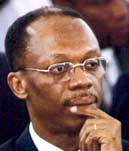
En
septembre 2002, Jean-Bertrand Aristide accuse les médias de vouloir déstabiliser
son gouvernement et les assimile aux auteurs du coup d’Etat de 1991. Pour la
profession, ces déclarations sont un message destiné aux "organisations
populaires", ces milices paralégales chargées de régler leur compte aux
détracteurs du Président. En 2002, une quarantaine de journalistes ont été
menacés ou agressés. Une spirale de la violence qui repose sur l’impunité
dont bénéficient ses auteurs. A commencer par les assassins des journalistes
Jean Dominique et Brignol Lindor. © RSF
Les
forces de l’ordre, accusées de passivité, de dérives mafieuses ou de
complicité avec le pouvoir, semblent incapables d’enrayer ce phénomène de déliquescence
de la vie publique. La manifestation anti-gouvernementale de dimanche, à
Port-au-Prince, a fait un mort et plusieurs blessés.
Comme
lors des précédents mouvements, la violence était une fois de plus au
rendez-vous de la manifestation anti-gouvernementale de dimanche. Plusieurs
milliers de personnes ont marché à l’appel de la Plate-forme démocratique
de la société civile et des partis d’opposition pour réclamer, une nouvelle
fois, le départ du président Jean-Bertrand Aristide.
Les
manifestants ont dû affronter les jets de pierres et de bouteilles de partisans
du chef de l’Etat, postés dans des ruelles et sur les toits sur le trajet de
la manifestation. Des coups de feu ont été tirés en dépit d’une protection
policière saluée par les manifestants eux-mêmes. Selon des témoins, c’est
après la dispersion du cortège, alors que les participants regagnaient leurs
foyers, qu’un manifestant a été tué par balle par des hommes armés
circulant sur des camions.
De
l’aveu même de certains participants, interrogés par l’AFP, la
manifestation de dimanche dans la capitale haïtienne a recruté moins de
partisans que les précédents rassemblements. Selon eux, cette désaffection
est à mettre au compte de la répression dont l’opposition est victime dans
les quartiers défavorisés. Néanmoins, après les attaques dont les
manifestants ont été la cible, dimanche, la police anti-émeute, réputée
favorable au régime, a riposté et procédé à plusieurs arrestations.
Protestations
internationales
Ces
nouveaux incidents surviennent peu après l’incendie volontaire de plusieurs
radios privées. Dans la nuit de samedi à dimanche, deux radios locales de la
commune de Saint Marc (à 96 km au nord de la capitale), Radio LJS (Lumière de
la jeunesse Saint-Marcoise) et Radio Delta ont été investies par un groupe
d’hommes en armes. Ils ont mitraillé les installations avant d’y mettre le
feu. Ces attaques n’ont pas été revendiquées. Jeudi dernier, deux autres
stations de la ville, considérées comme proches du pouvoir, Radio Pyramide et
Radio America, avaient subi le même sort. Le personnel et le directeur de la
première avaient été menacés de mort par les assaillants. Le studio d’émission
de la seconde se trouvait dans la maison du procureur de la République.
La
radicalisation des camps et des méthodes laisse le champ libre à de nombreux
extrémistes. Un ancien journaliste a été grièvement blessé par balle
vendredi soir aux Gonaïves, dans le nord-ouest du pays, lors d’un attentat
non-revendiqué, mais dont on n’est toutefois pas sûr que la victime était
bien la cible visée par les assaillants. Dans la journée, Port-au-Prince avait
été le théâtre d’une violente confrontation entre manifestants anti et
pro-Aristide, à l’occasion des obsèques d’un étudiant abattu dix jours
plus tôt lors d’une manifestation d’opposants. Bilan : cinq blessés,
dont trois par balles.
Les
attaques répétées contre la presse soulèvent une vague d’indignation tant
au niveau national qu’international. Après le sabotage commis mardi par un
commando d’inconnus armés contre huit stations de radios et une station de télévision
à Port-au-Prince, plusieurs communiqués de protestations ont été publiés.
L’Organisation des Etats américains a exprimé sa « vive préoccupation »
et demandé aux autorités d’engager une enquête sérieuse. L’Association
nationale des médias haïtiens a annoncé son intention de poursuivre les
auteurs devant les tribunaux. L’association Reporters sans frontières déclare
craindre la répétition de tels actes « si les auteurs ne sont pas
sanctionnés ». L’ambassadeur des Etats-Unis condamne. L’ambassadeur
de France les qualifie « d’inacceptables ». Enfin, tant le parti
au pouvoir, que le président, l’opposition et la classe politique dans son
ensemble dénoncent cette situation extrêmement préoccupante en raison des
graves menaces qu’elle comporte pour l’avenir du pays.
La
communauté régionale des Caraïbes Caricom, dont Haïti est membre, va tenter
dès cette semaine une médiation. Ses représentants rencontreront à partir de
mardi les membres de l’opposition, de l’Eglise et de la société civile.
Puis ils mèneront des entretiens ultérieurement avec le président
Jean-Bertand Aristide. La mission aura lieu aux Bahamas et sera conduite par le
Premier ministre jamaïcain.
Georges ABOU - RFI
http://radio-canada.ca/nouvelles/International/nouvelles/200401/19/007-haiti-lundi.shtml
Haïti:
assaut d'un poste de police
Mise
à jour le lundi 19 janvier 2004 à 22 h 38
En
Haïti, des militants de l'opposition ont attaqué à l'arme automatique un
poste de police aux Gonaïves, au nord-ouest du pays. Personne n'a été blessé,
selon un journaliste local.
Peu après cette attaque, des membres du Front de résistance révolutionnaire
ont brûlé dans la rue le mobilier de deux maisons appartenant à des policiers
originaires de la ville.
|
|
|
Depuis
trois mois, les étudiants décrient la «dérive dictatoriale» du président
Aristide. . |
À
Port-au-Prince, la police anti-émeute a dispersé quelque 200 étudiants et
professeurs qui réclamaient la démission du président Aristide.
Entre-temps, à Nassau aux Bahamas, les leaders de l'opposition haïtienne sont
réunis et doivent bientôt prendre part à des négociations avec des membres
du CARICOM, pour tenter de trouver une solution à la crise.
Le président Aristide a déclaré samedi qu'il craignait un coup d'État. La
semaine dernière, il s'est prononcé en faveur de la tenue d'élections dans le
courant des six prochains mois. Mais l'opposition réclame sa démission avant
la tenue d'un nouveau scrutin.
http://www.haiti-info.com/article.php3?id_article=1136
Un
mort et trois blessés par balles aux Gonaïves
26 janvier 2004
Une
personne a été tuée et trois autres blessées par balles lors de deux
incidents séparés lundi dans la ville côtière des Gonaïves (nord-ouest), a
annoncé à l’AFP un journaliste local.
Un
passant a d’abord été tué par balles dans la zone du commissariat de la
ville lors d’un échange de coups de feu entre la police et des opposants armés
au président Jean Bertrand Aristide, membres du Front de résistance révolutionnaire
de l’Artibonite.
Les
membres du Front avaient auparavant bloqué une des principales artères de la
ville, brûlant des pneus et barrant la rue avec des voitures, et tirant des
coups de feu en l’air pour créer la panique avant l’arrivée de la police.
Par
la suite, des membres du Front ont menacé d’exécuter dans le quartier de
Raboteau trois personnes accusées d’être des collaborateurs de la police,
mais devant les protestations des riverains, se sont contentés de leur tirer
une balle dans le pied à chacune.
Ce
nouvel incident porte à 48 morts et 97 blessés par balles le bilan des
violences sporadiques dont la ville est le théâtre depuis septembre dernier.
La
reproduction, la redistribution ou la syndication du texte ci-dessus, dans son
intégralité ou en partie, nécessitent l'autorisation préalable et expresse
de AFP.
http://www.haiti-info.com/article.php3?id_article=1139
Plus
de 15.000 personnes à une nouvelle manifestation contre Aristide à
Port-au-Prince
27 janvier 2004
PORT-AU-PRINCE
(AP) — Plus de 15.000 Haïtiens ont défilé mardi dans le calme pour réclamer
le départ du président Jean-Bertrand Aristide, dans ce qui est devenu une
manifestation quasi-quotidienne de rejet du régime. Les manifestants sont
partis de la banlieue de Pétionville en direction du centre-ville de
Port-au-Prince. La foule scandait en créole « Si Aristide reste, nous
finirons tous boat people ! », en reférence à l’exode du début
des années 90, des milliers d’Haïtiens se jetant à la mer, espérant gagner
les Etats-Unis, pour fuir les violences qui suivirent le renversement
d’Aristide, en 1991.
Ramené
dans les bagages de l’invasion américaine en 1994, le président, réélu en
2000 lors d’un scrutin contesté après avoir cédé les commandes quelques
années, est désormais dénoncé dans des manifestations quasi-quotidiennes, et
Haïti plongé dans la tourmente. Dans le même temps, des témoins ont fait état
de la mort d’un passant, tué lundi par une balle perdue lors d’un
affrontement entre policiers et manifestants anti-Aristide à Gonaïves, deuxième
ville du pays, sur la côte ouest.
Les
manifestants auraient également incendié une station service et la maison
d’un policier. Au cours des quatre derniers mois, au moins 46 personnes ont été
tuées au cours ou en marge des manifestations anti-gouvernementales. La plus
grosse de ces manifestations a réuni des dizaines de milliers de personnes le
11 janvier dernier.
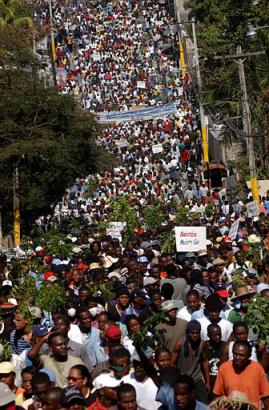
Anti-Aristide protesters march in Port-au-Prince, Haiti,
Tuesday, Jan 27, 2004. More than 15,000 people demonstrated peacefully against
President Jean-Bertrand Aristide Tuesday in what has become a near daily show of
popular defiance against the elected leader. (AP
Photo/Rodrigo Abd)
La
reproduction, la redistribution ou la syndication du texte ci-dessus, dans son
intégralité ou en partie, nécessitent l'autorisation préalable et expresse
de Associated Press.
http://www.haiti-info.com/article.php3?id_article=1143
11 wounded in mounting anti-government protests in
27
janvier 2004
Eleven people were shot and wounded on Tuesday by
pro-government militants, as protests demanding the resignation of Haitian
President Jean-Bertrand Aristide spread across the
Armed supporters of Aristide shot and injured 11 people
who were protesting against the government in the southwestern city of
Petit-Goaves, according to a radio report citing medical officials.
At least 15,000 people marched through the capital, in
the second consecutive day of protests, calling for Aristide to step down.
One person was killed in the town of Gonaives on Monday
during clashes between police and an opposition militia.
Organiser Andre Apaid, of the Democratic Platform, said
the protesters wanted to send a message to the Caribbean Community (Caricom),
which at the weekend urged Haiti’s rival groups to seek a peaceful end to the
tensions that have been mounting since disputed May 2000 elections.
The opposition has rejected Caricom’s efforts
insisting that Aristide and his government must step down.
Protests intensify
Protests for and against the government have mounted in
recent weeks, with several of them ending in violence.
The National Police announced it would restrict
protests to one section of Port-au-Prince, saying it was taking this step out of
security concerns.
Demonstrations would have to be held at Place
d’Italie, a vast ocean-front esplanade located between the US embassy’s
chancery and the Haitian foreign ministry.
Protest organisers refused to meet with the National
Police to discuss demonstration routes, police said in a statement.
"Some demonstrations are followed with
violence," police said. "According to information gathered by (the
National Police’s) intelligence service, individuals with bad intentions are
ready to continue dishonest acts to disrupt schools and stop peaceful citizens
from going about their business," police said.
La
reproduction, la redistribution ou la syndication du texte ci-dessus, dans son
intégralité ou en partie, nécessitent l'autorisation préalable et expresse
de AFP.
http://www.kansascity.com/mld/kansascity/7818351.htm
Posted on
Haitian
Student Killed During Protest
Associated Press
PORT-AU-PRINCE,
Haiti - Angry students
protesting against President Jean-Bertrand Aristide burned a coffin in front of
the U.S. Consulate on Wednesday. One student was shot and killed.
Riot police fired tear gas and warning
shots to disperse students and Aristide partisans who were pelting the
demonstrators with rocks.
One student was shot and killed near the
consulate, apparently by a gun-fired tear gas canister that hit him in the back
and caused internal bleeding, said Dr. Eric Cantave, who removed the canister
from the student's back.
Dozens of students and parents crowded into
the capital's main Canape Vert Hospital, sobbing and shouting anti-government
slogans.
Haiti has been in turmoil since Aristide's
Lavalas Family party swept 2000 legislative elections that observers said were
flawed. In the past four months, at least 50 people have been killed.
The students want the United States to help
them in calling for Aristide's resignation. U.S. troops restored Aristide to
power in 1994 after a coup.
"The United States is an important
factor in the crisis. It has to assume its responsibility," University of
Haiti student leader Herve Saintilus said.
Officials temporarily shut down the U.S.
Consulate because of the unrest, said Judith Trunzo, a spokeswoman for the U.S.
Embassy, which remained open and is about one mile from the consulate.
The protest was held outside the Consulate
in defiance of a police order that limited demonstrations to a seaside square.
There was no immediate police comment about
Wednesday's shooting.
Caribbean leaders have been trying to solve
the country's three-year political impasse, meeting in the Bahamas last week
with Haitian opposition members and with Aristide on Sunday.
Aristide will meet with regional leaders on
Friday in Jamaica.
The opposition says it will not hold talks
with the government or participate in new elections unless Aristide resigns.
Aristide has said he plans to serve out his term, which ends in 2006.
"Aristide is pitting the police
against the people," opposition politician Evans Paul said.
Police broke up three student demonstrations last week with tear gas,
saying they weren't complying with a 1987 decree requiring protesters to submit
plans two days before and to give names of participants.
http://www.ndtv.com/morenews/showmorestory.asp?slug=Haiti+protest+grows+intense&id=48092
Haiti
protest grows intense
Angry
students protesting on Wednesday against Haiti President Jean-Bertrand
Aristide's rule occupied a hospital in Port-Au-Prince where a man slain in
street clashes with the police had been taken.
The victim was identified as 29-year-old Lionel Victor who was a supporter of
Aristide's Lavalas Family party.
But some protesters said they thought Victor was a student demonstrating against
the government.
Dozens of students crowded into the waiting room of the capital's Canape Vert
Hospital where Victor's body was brought, sobbing and shouting anti-government
slogans.
Riot police then stormed the hospital and arrested 15 people.
The protests began earlier on Wednesday when students burned a coffin in front
of the US Consulate.
Riot police fired tear gas and warning shots to pro-government factions who were
pelting the demonstrators with rocks.
One protester was killed after being struck by a tear gas canister that
punctured his back and caused internal bleeding.
Haiti has been in turmoil since Aristide's Lavalas Family party swept 2000
legislative elections that observers said were flawed.
In the past four months, at least 50 people have been killed. (AP)
http://search.news.yahoo.com/search/news/?c=news_photos&p=riot
In
front of the U.S Consulate, a riot policeman throws tear gas to
university students during an anti Aristide protest in
AP - Jan 28
http://www.canada.com/news/monde/story.html?id=E311EA13-9268-4EFF-B4C6-CAF075572099
Un étudiant tué au cours
d'une manifestation en Haïti
Wednesday, January 28, 2004
PORT-AU-PRINCE (AP) -
Un étudiant a été tué mercredi au cours d'une manifestation contre le président
haïtien Jean-Bertrand Aristide devant l'e Consulat des Etats-Unis à
Port-au-Prince. Les manifestants ont brûlé un cercueil et la police anti-émeutes
est intervenue à coups de gaz lacrymogènes et de tirs d'avertissement.
Des partisans
d'Aristide s'en sont également pris aux manifestants à coups de pierres.
L'étudiant a été tué
non loin du consulat, apparament par un projectile de gaz lacrymogène qui lui a
percé le dos et provoqué une hémorragie internet, selon le docteur Eric
Cantave.
Des dizaines de proches
et d'étudiants se sont ensuite retrouvés dnas l'hôpital principal de la
ville, pleurant et criant des slogans anti-gouvernementaux. Hervé Saintilus,
dirigeant étudiant, a estimé que les Etats-Unis, "important facteur dans
la crise", devaient "assumer leur responsabilité".
Haïti s'enfonce dans
la crise, déclenchée en 2000 lors des élections remportées par le parti
d'Aristide, la Famille Lavalas, et dénoncées par l'opposition. Ces quatre
derniers mois, au moins 50 personnes sont mortes dans les affrontements et
violences qui secouent le pays, et où les manifestations réclamant le départ
d'Aristide sont quasiment quotidiennes.
Les dirigeants régionaux
des Caraïbes tentent d'aider Haïti, un des pays les plus pauvres de la planète,
à sortir de l'impasse. Aristide doit les rencontrer à nouveau vendredi en Jamaïque.
http://www.cnn.com/2004/WORLD/americas/01/29/haiti.protest.ap/
"Arrest
Aristide! We're tired of dead bodies!" about 100 protesters shouted as they
accompanied a hearse from a Roman Catholic church to the capital's municipal
cemetery.
Police
accompanied the procession, which ended without incident.
The student,
Emmanuel Colastin, 15, died January 18 when gunmen opened fire from a car and
hit him as he was walking on a boulevard after an anti-government protest march
that had drawn thousands. Colastin had not participated in the demonstration,
but the opposition Democratic Platform accused "the bandits of the Aristide
regime" of having killed him.
Haiti has been
in turmoil since Aristide's Lavalas Family party swept 2000 legislative
elections that observers said were flawed. In the past four months of protest,
at least 50 people have been killed.
Aristide
partisan Lionel Victor, 29, was killed Wednesday after a tear gas canister shot
by police struck him in the back. He was among a group of Aristide supporters
countering an anti-government demonstration held by university students outside
the U.S. Consulate.
Believing
Victor had been an anti-government demonstrator, students crowded into the
waiting room of a hospital, sobbing and shouting anti-government slogans.
Later, they
built a flaming tire barricade outside the Canape Vert hospital. Riot police
stormed the hospital and detained at least 15 people. Eleven were later released.
One police officer was injured by a rock.
Saying they
want to prevent fresh outbreaks of violence, police on Tuesday ordered
demonstrations in the capital be held in a seaside square, kilometers (miles)
away from the National Palace.
Caribbean
Community leaders have been trying to help Haiti out of its three-year political
impasse, meeting in the Bahamas last week with Haitian opposition members and
with Aristide in Haiti on Sunday.
Aristide was
planning to meet regional leaders Saturday in Jamaica, the regional bloc's
Assistant-Secretary General Colin Granderson told The Associated Press on
Thursday.
The opposition
said it would not hold talks with the government or participate in new elections
unless Aristide resigns. Aristide has said he plans to serve out his term, which
ends in 2006.
http://www.channelnewsasia.com/stories/afp_world/view/69056/1/.html
Protesters march peacefully
against Haitian president
Anti-riot police watched as demonstrators, some with their children in tow,
demanded Aristide's resignation and urged the government to free political
prisoners.
Andre Apaid, an opposition leader, told AFP that "we have to demand that we
stop frightening the Haitian people."
The Caribbean Community (Caricom), a 15-nation group trying to solve the Haitian
crisis, "will finally understand that all Haitians want Mr. Aristide's
resignation," Apaid said.
Upon his return from Jamaica Saturday, Aristide said he would consider
overturning police measures restricting protests in the capital to a seafront
square near city hall.
"Everybody has the right to demonstrate as long as everyone respects the
law and works with police for the organization of these demonstrations,"
Aristide said late Saturday after meeting with Jamaican Prime Minister Percival
Patterson, the Caricom president.
Citing security concerns, police on Tuesday restricted protests in
Port-au-Prince to the Place d'Italie square.
The opposition, which has stepped up calls for Aristide's resignation, denounced
the police restrictions as "unconstitutional."
Anti-Aristide demonstrators have clashed frequently with pro-government groups
and police, and fresh violence this weekend took the death toll higher.
Aristide, a former priest who had served a five-year term in the 1990s, was re-elected
in 2000. Observers and opposition parties, however, claim Aristide's party
rigged the vote.
The Haitian president also announced Saturday that he will release in late March
a schedule for the creation of an electoral council and special advisory panel.
Caricom urged Aristide to consider a plan by Haitian church leaders to create a
special advisory council comprised of political parties, religious organizations
and human rights groups. The panel would help organize elections.
Meanwhile violence continued this weekend. An eyewitness told AFP that two
people were killed and five were injured during a police operation in Gonaives,
in northwest Haiti, overnight Friday and Saturday.
With the killings, the death toll in Gonaives rose to at least 49. Another 99
people have been injured in Gonaives since September 23, when the anti-government
Artibonite Revolutionary Resistance Front took arms.
A policeman was killed overnight Friday and Saturday in Miragoane, in the
southwest, as he intervened in a clash that broke out at a funeral attended by
government loyalists.
Citing civil unrest, the United States decided Friday to reduce its diplomatic
presence in Haiti.
- AFP
http://www.haiti-info.com/article.php3?id_article=1167
Importante
manifestation de l’opposition à Port-au-Prince
1er février 2004
Des dizaines de milliers de personnes
ont défilé sans incident dimanche à Port-au-Prince à l’appel de
l’opposition pour réclamer la démission du président Jean Bertrand
Aristide, a constaté l’AFP.
Les manifestants qui ont défilé sous
la protection de la police anti-émeute, ont réclamé la démission du chef de
l’État et la libération des prisonniers politiques.
Des enfants accompagnés de leurs
parents participaient à la manifestation.
Dans une déclaration à l’AFP,
l’un des responsables de la Plate-forme démocratique de la société civile
et des partis de l’opposition, André Apaid, a estimé que « l’on
devait exiger que l’on cesse de faire peur au peuple haïtien » et que
« la position de la Caricom évoluait et qu’elle finirait par comprendre
que tout le peuple haïtien veut la démission de M. Aristide ».
Le président Aristide doit achever son
deuxième et dernier mandat de cinq ans le 7 février 2006. Le président haïtien
écarte toute amputation de son quinquennat alors que l’opposition exige sa démission.
La reproduction, la redistribution ou
la syndication du texte ci-dessus, dans son intégralité ou en partie, nécessitent
l'autorisation préalable et expresse de AFP.
http://www.edicom.ch/news/international/040204045342.we.shtml
Haïti: un adolescent tué lors d'une manifestation
4
février 2004
PORT-AU-PRINCE
- Un adolescent a été tué par balle mardi par la police lors d'une
manifestation anti-gouvernementale dans la ville frontière de Ouanaminthe, dans
le nord-est du pays, ont annoncé plusieurs radios privées haïtiennes. Il y a
aussi des blessés.
Entre
trois et dix personnes, selon les radios, ont également été blessées par
balle lors des incidents. Les manifestants réclamaient la démission du président
Jean Bertrand Aristide.
A
Port-au-Prince, des étudiants de la Faculté des Sciences humaines, principal
bastion estudiantin de l'opposition, ont érigé mardi des barricades autour de
leur établissement. La police a répliqué par des tirs de grenades lacrymogènes.
Par
ailleurs le ministre des Affaires Etrangères des Bahamas, Frederick Mitchell,
est arrivé mardi à Port-au-Prince dans le cadre de la médiation entreprise
par la Caricom (Organisation des pays Caraïbes) pour tenter de trouver un
compromis politique à l'interminable crise haïtienne.
M.
Mitchell, qui est accompagné de l'ambassadeur Colin Granderson (Trinité et
Tobago), secrétaire général adjoint de la Caricom, s'entretiendra mardi à
l'ambassade des Bahamas dans la capitale haïtienne avec des responsables de la
Plate-forme de la société civile et des partis de l'opposition. Il doit également
avoir une entrevue avec le président Aristide avant son départ jeudi.
©
ATS